
Bakelite vs POM vs Aluminum: How to Choose Wire Harness Fixture Material
Why fixture material matters more than you think
Material selection directly decides how long a wire harness fixture lasts, how precisely it positions cables, and how much it costs over a production year. Many harness manufacturers pick material by habit instead of by requirement, which leads to premature wear, frequent re-tooling and higher defect rates.
In this guide we compare the three most common materials for dụng cụ cố định cụm dây điện production — bakelite, POM (Delrin) and aluminum — across cost, precision, wear resistance and best application, so you can choose the right one for your harness line.
The 3 common materials at a glance
Bakelite
Bakelite (phenolic laminate) is the most widely used material for harness routing boards. It is pressed paper or cloth resin laminate, machined into locating pins, routing channels and board bodies.
- Low material and machining cost
- Good dimensional stability under normal workshop temperature
- Easy to machine into complex routing layouts
- Excellent value for mass production lines
POM (Delrin)
POM is an engineering plastic known for low friction and high precision. It is preferred for small, delicate cable jigs and fixtures that must not scratch insulation.
- Smooth, low-friction surface protects wire insulation
- High dimensional precision and repeatability
- Better wear resistance than bakelite in moving/sliding contact
- Higher cost and sensitive to prolonged high temperature
Aluminum
Aluminum fixture bodies are light but rigid, and can be anodized for a hard, corrosion-resistant surface. It suits heavy-duty or frequently changed workstations.
- High rigidity for large boards and heavy connectors
- Lightweight yet durable
- Anodizing resists wear and corrosion
- Higher machining cost; conductive — needs insulation on test areas
Side-by-side comparison
| Factor | Bakelite | POM (Delrin) | Aluminum |
|---|---|---|---|
| Relative cost | ★ Low | ★★ Medium | ★★★ High |
| Wear resistance | Good | Very good | Excellent (anodized) |
| Precision / tolerance | ±0.05 mm | ±0.02 mm | ±0.02 mm |
| Surface friction | Medium | Low (smooth) | Medium |
| Wire insulation protection | Good | Best | Needs insulation |
| Heat resistance | Good | Moderate | Excellent |
| Weight | Heavy | Light | Light |
| Best application | Standard auto harness routing board, mass production | Small precision cable jigs, aerospace prototype | Heavy-duty station, frequent model change |
Key takeaway: bakelite wins on cost and is the default for mainstream harness assembly. POM wins where precision and insulation protection matter most. Aluminum wins where rigidity and heavy use matter and budget allows.
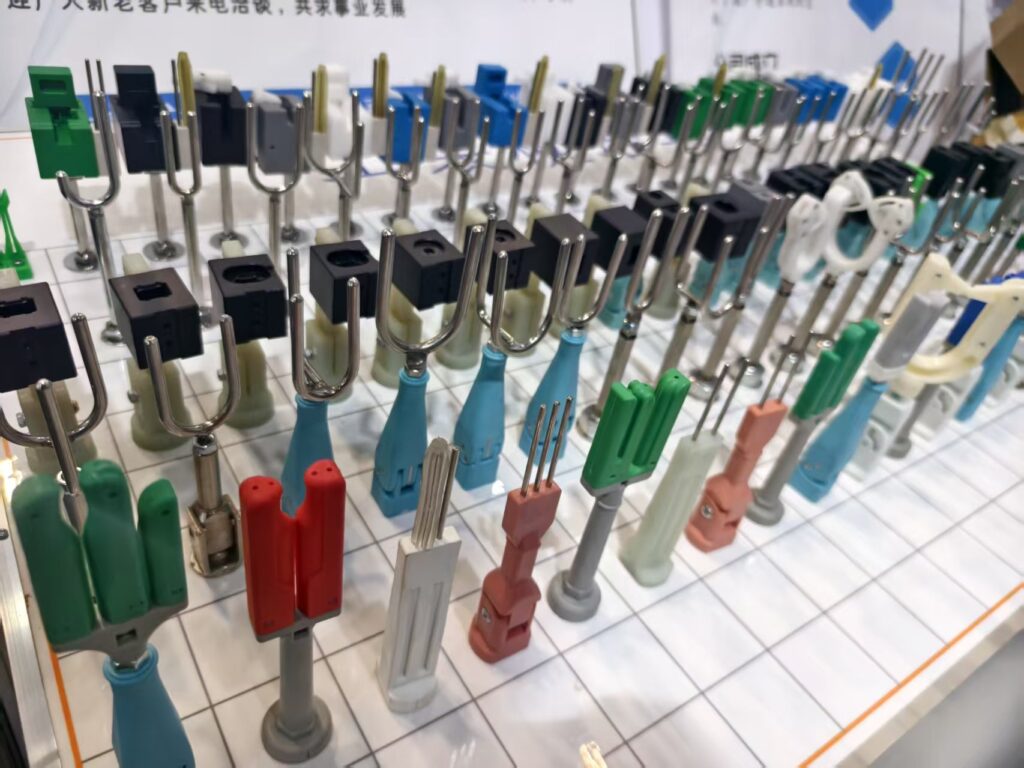
How to choose — a practical decision guide
Choose bakelite when:
- You run high-volume standard harness assembly (automotive, home appliance)
- Fixture layout changes are frequent and cost-sensitive
- Tolerance requirement is standard (±0.05 mm)
- You want the fastest lead time at lowest budget
Choose POM when:
- Cables have delicate insulation that must not be scratched
- You need tight positioning tolerance for small connectors
- Aerospace or high-end automotive prototype batches
- You need low-friction sliding guides
Choose aluminum when:
- Fixtures hold heavy connectors or large boards
- Workstation is used continuously and subject to impact
- You change fixtures often and need durability
- Anodized surface is required for clean, corrosion-resistant finish
3 common material mistakes we see in harness workshops
Mistake 1 — Using bakelite for ultra-thin boards Thin bakelite warps under repeated clamping, causing routing channels to shift and misalign pins. Solution: keep board thickness ≥ 12 mm for standard sizes, or use aluminum backing.
Mistake 2 — Choosing POM near heat sources POM softens under prolonged heat, for example near soldering or heat-staking stations. For hot workstations, aluminum or bakelite is safer.
Mistake 3 — Aluminum without insulation on test points Aluminum conducts electricity. On continuity test fixtures, bare aluminum near connector pins can cause short circuits. Use insulation bushings or coating on test areas.
Câu hỏi thường gặp
Q1: Which material is cheapest for a wire harness fixture? A: Bakelite is the most cost-effective for standard routing boards. POM and aluminum cost more but last longer in specific conditions.
Q2: Can you combine materials in one fixture? A: Yes. A common design is a bakelite board with aluminum mounting frame or POM locating pins. We recommend the best combination based on your drawing.
Q3: Do you provide material certificates for automotive projects? A: Yes, we can issue material certificates for bakelite, POM and aluminum used in your fixture, supporting automotive and IATF-aligned projects.
CTA
If you are not sure which material fits your wire harness production, send your harness drawing to our engineering team for a free technical review and quotation. We will recommend the material, layout and tolerance based on your actual project.