
Why harness assembly defects happen in mass production
Wire harness assembly is a highly manual process in automotive, EV, home appliance and aerospace production. Even with standardized SOPs, repeated human operation, inconsistent routing and inaccurate positioning always lead to stable defect rates in long-term mass production.
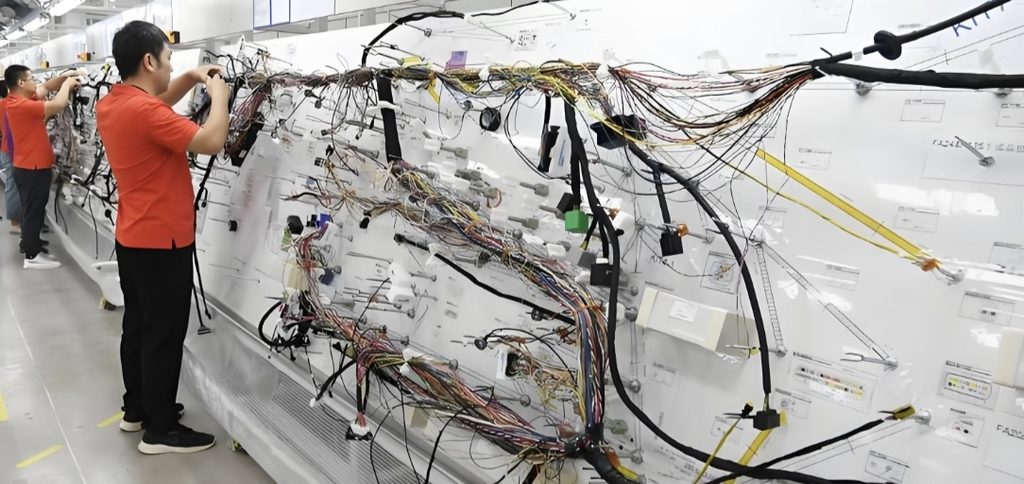
Most workshop managers try to reduce errors by training workers or tightening inspection standards, but the improvement is limited. The fundamental solution is process tooling improvement. A well-designed wire harness fixture can standardize cable routing, fix positioning tolerance and eliminate human error.
This technical guide summarizes the 6 most common harness assembly defects, analyzes root causes, and provides targeted fixture optimization solutions for production lines.
6 Typical Wire Harness Assembly Defects in Workshop Production
1. Wrong Cable Routing & Crossed Wires
Phenomenon: Workers route wires through incorrect grooves, causing twisted cables, wrong wiring sequences and inconsistent harness shapes.
Root Cause: Pure manual routing relies on worker experience; no fixed routing reference boundary.
2. Improper Connector Positioning
Phenomenon: Connectors are offset, tilted or installed in wrong directions, resulting in assembly failure at downstream stations.
Root Cause: No fixed locating base for connectors; manual alignment error accumulates in batch production.
3. Unstable Cable Length & Loose Layout
Phenomenon: The same harness model has inconsistent cable margin length, too loose or too tight layout, affecting final vehicle assembly.
Root Cause: Lack of fixed limiting pins and routing channels; free assembly leads to inconsistent tension control.
4. Terminal Crimp Offset & Pin Misalignment
Phenomenon: After crimping, partial pins are misaligned, causing poor contact or open circuit after final assembly.
Root Cause: No auxiliary positioning fixture during crimping and wiring process.
5. Wire Insulation Scratches & Damage
Phenomenon: Cable skin is scratched, worn or squeezed during repeated assembly.
Root Cause: Rough workbench surface, no smooth guiding structure, improper manual dragging.
6. Low Testing Pass Rate (Hidden Open/Short Circuit)
Phenomenon: Finished harnesses fail continuity test due to invisible wiring errors.
Root Cause: Early-stage routing errors are not intercepted, forming hidden quality risks.
Defect vs. Fixture Solution: One-to-One Improvement Strategy
The core value of wire harness tooling is standardizing manual behavior. Below is the targeted fixture solution for each production problem.
| Assembly Defect | Fixture Optimization Solution | Improvement Effect |
|---|---|---|
| Wrong cable routing / crossed wires | Custom routing board with fixed groove layout, exclusive channel for each wire sequence | Zero routing error, fully standardized wire sequence |
| Connector offset & tilt | Fixed connector positioning base & anti-reverse foolproof structure | Eliminate manual alignment deviation |
| Unstable cable length & loose layout | Limit pins and tension control blocks to fix cable margin | 100% consistent harness appearance and length |
| Terminal pin misalignment | Precision positioning fixture for crimping and pre-assembly | Reduce pin position deviation within ±0.02mm |
| Wire insulation scratch damage | Smooth POM guiding groove + rounded corner treatment | Protect cable skin, eliminate friction damage |
| Hidden open/short circuit risk | Match with custom continuity test fixture for post-assembly inspection | 100% full inspection coverage |
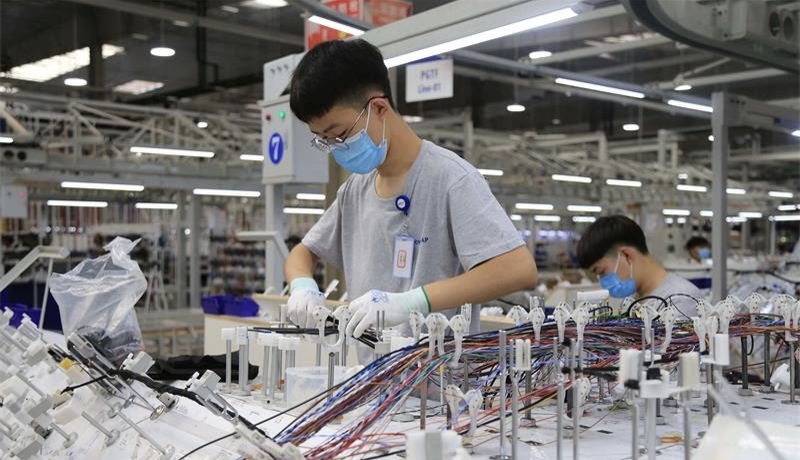
3 Typical Workshop Tooling Mistakes That Cause High Defect Rates
Mistake 1: Using Universal Simple Jigs for Multi-Model Harnesses
Many factories reuse old simple fixtures for new harness models. Universal jigs lack dedicated routing channels and foolproof structures, which cannot adapt to new wiring sequences, resulting in continuous wrong routing defects.
Solution: Custom exclusive routing board for each core harness model.
Mistake 2: Ignoring Foolproof Design for Manual Assembly
Workers rely on memory for repeated work. Without foolproof structures, fatigue and human error are inevitable in long shifts.
Solution: Add anti-reverse, anti-misplug and exclusive positioning limit on fixture design.
Mistake 3: Low-precision Fixture for High-End Automotive/EV Harness
New energy and automotive harnesses require strict tolerance control. Ordinary low-precision bakelite jigs cannot meet high-standard production requirements, leading to batch rework.
Solution: Upgrade to POM precision positioning or aluminum reinforced fixture structure.
How Much Can a Custom Fixture Reduce Defect Rate?
According to mass production data of cooperative harness factories:
- Wrong routing defect rate: reduced by 85%–95%
- Connector assembly error: reduced by over 90%
- Cable scratch and damage rate: reduced to nearly zero
- Overall rework cost: saved by 15%–25% monthly
Custom harness fixtures turn “worker-dependent production” into “tooling-dependent production”, which is the core of standardized harness workshop management.
FAQ
Q1: Do I need a new fixture for every new harness model?
A: For stable mass production, exclusive custom routing fixtures are recommended. For multi-model small-batch production, we can design modular quick-change fixtures to save cost.
Q2: Can fixture solve intermittent hidden wiring errors?
A: Yes. Fixed routing channels and positioning structures eliminate random manual errors, greatly reducing hidden quality risks in harness assembly.
Q3: Is custom fixture cost-effective for small batch production?
A: Yes. Our MOQ is 1 set. Even prototype batches can use custom fixtures to ensure consistent assembly quality and avoid project verification failure.
Get Custom Fixture Solution for Your Production Line
If your workshop is facing high rework rate, unstable assembly quality or frequent wiring errors, send your harness drawing and defect problems to our engineering team. We provide custom fixture design, targeted optimization scheme and one-stop tooling solution for automotive, new energy and aerospace harness production.